With This Rinse, Performance Improves (New York Times, July 19, 2010)
* "Exercise scientists say they have stumbled on an amazing discovery. Athletes can improve their performance in intense bouts of exercise, lasting an hour or so, if they merely rinse their mouths with a carbohydrate solution. They don’t even have to swallow it."
* "It has to be real carbohydrates, though; the scientists used a solution of water and a flavorless starch derivative called maltodextrin. Artificial sweeteners have no effect."
* "And the scientists think they have figured out why it works. It appears that the brain can sense carbohydrates in the mouth, even tasteless ones. The sensors are different from the ones for sweetness, and they prompt the brain to respond, spurring on the athlete."
Saturday, 31 July 2010

Mood
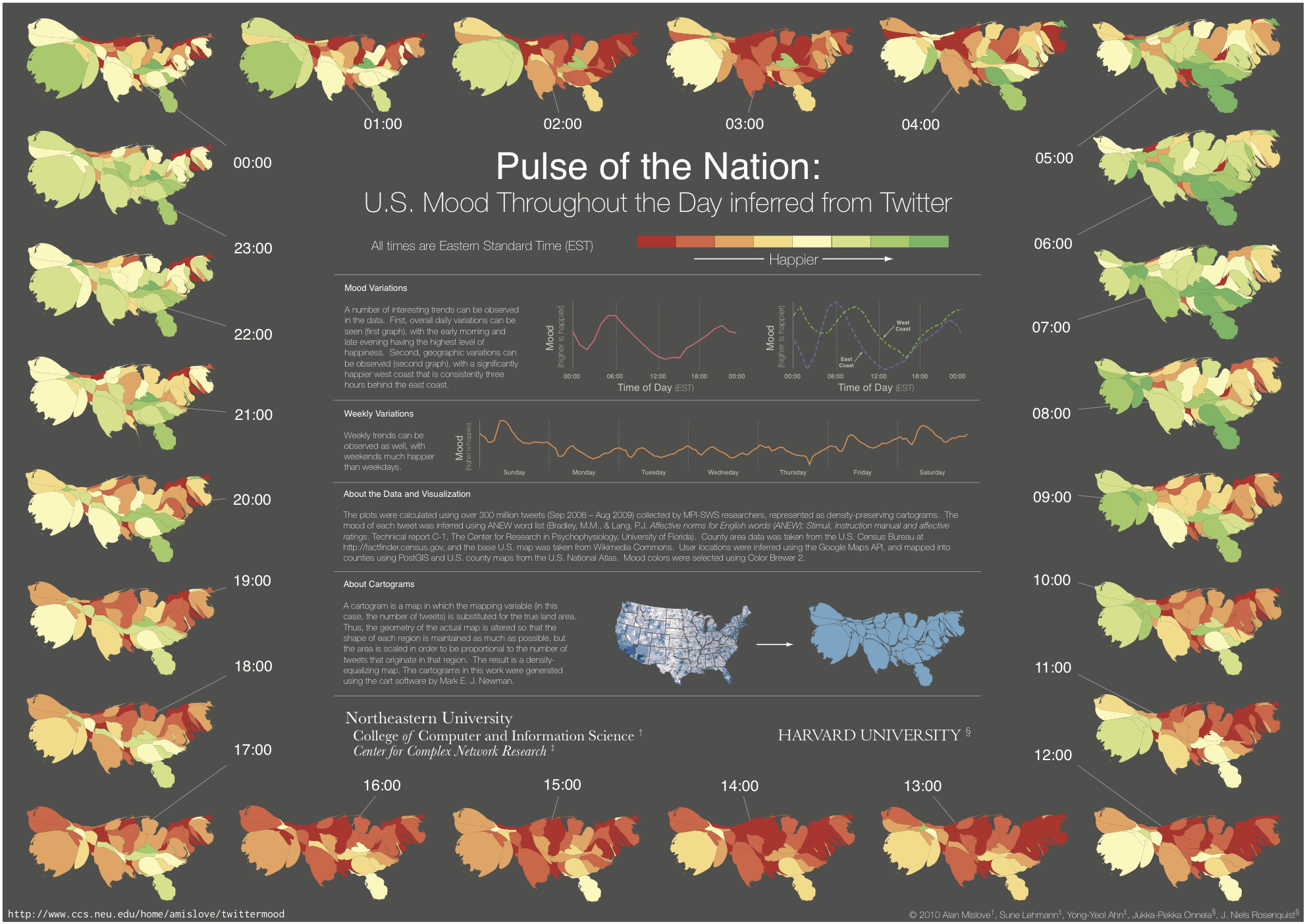
Pulse of the Nation: U.S. Mood Throughout the Day inferred from Twitter (Poster)
* This poster attempts to gauge the mood throughout the day of America's 7% Twitter Users.
Pulse of the Nation: U.S. Mood Throughout the Day inferred from Twitter (Youtube Video)
* This poster attempts to gauge the mood throughout the day of America's 7% Twitter Users.
Pulse of the Nation: U.S. Mood Throughout the Day inferred from Twitter (Youtube Video)
Cognitive Decline
Handgrip strength and cognitive decline in older Mexican Americans. [PubMed Abstract]
* "CONCLUSION: Older Mexican Americans with reduced handgrip strength at baseline demonstrated a statistically significant decline in cognitive function over a 7-year period. By contrast, participants in the highest handgrip strength quartile maintained a higher level of cognitive function."
* Alfaro-Acha A, Al Snih S, Raji MA, Kuo YF, Markides KS, Ottenbacher KJ.
* J Gerontol A Biol Sci Med Sci. 2006 Aug;61(8):859-65.
Handgrip Strength
Handgrip strength and mortality in the oldest old population: the Leiden 85-plus study
* "Handgrip strength, a surrogate measurement of overall muscular strength, is a predictor of all-cause mortality in the oldest old population and may serve as a convenient tool for prognostication of mortality risk among elderly people."
* Carolina H.Y. Ling, MD, Diana Taekema, MD, Anton J.M. de Craen, PhD, Jacobijn Gussekloo, MD PhD, Rudi G.J. Westendorp, MD PhD and Andrea B. Maier, MD PhD
* CMAJ • March 23, 2010; 182 (5). First published February 8, 2010; doi:10.1503/cmaj.091278
Handgrip strength and cognitive decline in older Mexican Americans. [PubMed Abstract]
* "CONCLUSION: Older Mexican Americans with reduced handgrip strength at baseline demonstrated a statistically significant decline in cognitive function over a 7-year period. By contrast, participants in the highest handgrip strength quartile maintained a higher level of cognitive function."
* Alfaro-Acha A, Al Snih S, Raji MA, Kuo YF, Markides KS, Ottenbacher KJ.
* J Gerontol A Biol Sci Med Sci. 2006 Aug;61(8):859-65.
* "Handgrip strength, a surrogate measurement of overall muscular strength, is a predictor of all-cause mortality in the oldest old population and may serve as a convenient tool for prognostication of mortality risk among elderly people."
* Carolina H.Y. Ling, MD, Diana Taekema, MD, Anton J.M. de Craen, PhD, Jacobijn Gussekloo, MD PhD, Rudi G.J. Westendorp, MD PhD and Andrea B. Maier, MD PhD
* CMAJ • March 23, 2010; 182 (5). First published February 8, 2010; doi:10.1503/cmaj.091278
* "CONCLUSION: Older Mexican Americans with reduced handgrip strength at baseline demonstrated a statistically significant decline in cognitive function over a 7-year period. By contrast, participants in the highest handgrip strength quartile maintained a higher level of cognitive function."
* Alfaro-Acha A, Al Snih S, Raji MA, Kuo YF, Markides KS, Ottenbacher KJ.
* J Gerontol A Biol Sci Med Sci. 2006 Aug;61(8):859-65.
Monday, 19 July 2010
Anosmia
Homeopathic treatment works! (But not in a good way.) - July 19, 2010 (Nature Blog)
* "Terence Davidson and Wendy Smith, of the University of California, San Diego, looked at a set of nine criteria* for establishing a causal relationship and concluded that zinc nasal therapy can cause smell loss (anosmia). Their paper also details 25 patients who turned up at their Nasal Dysfunction Clinic complaining of smell loss after use of homeopathic zinc gel – which, unusually for a homeopathic treatment, does have an active ingredient."
* "Terence Davidson and Wendy Smith, of the University of California, San Diego, looked at a set of nine criteria* for establishing a causal relationship and concluded that zinc nasal therapy can cause smell loss (anosmia). Their paper also details 25 patients who turned up at their Nasal Dysfunction Clinic complaining of smell loss after use of homeopathic zinc gel – which, unusually for a homeopathic treatment, does have an active ingredient."
Zinc Gluconate
Homeopathic treatment works! (But not in a good way.) - July 19, 2010 (Nature Blog)
* "Concerns that popular ‘homeopathic’ cold remedy zinc gluconate can cause a loss of smell have been around for a while. Now an analysis by two San Diego researchers shows these concerns may be well founded."
* "Concerns that popular ‘homeopathic’ cold remedy zinc gluconate can cause a loss of smell have been around for a while. Now an analysis by two San Diego researchers shows these concerns may be well founded."
Homeopathic Treatment
Homeopathic treatment works! (But not in a good way.) - July 19, 2010 (Nature Blog)
* "Concerns that popular ‘homeopathic’ cold remedy zinc gluconate can cause a loss of smell have been around for a while. Now an analysis by two San Diego researchers shows these concerns may be well founded."
* "Concerns that popular ‘homeopathic’ cold remedy zinc gluconate can cause a loss of smell have been around for a while. Now an analysis by two San Diego researchers shows these concerns may be well founded."
Subscribe to:
Posts (Atom)